
Data Analysis How Much Does Raydium Really Rely on pump.fun?



Original Title: "Data Analysis: How Dependent Is Raydium on pump.fun?"
Original Author: Azuma, Odaily Planet Daily
The mainstream DEX protocol on Solana, Raydium (RAY), experienced a sharp decline today, directly triggered by pump.fun seemingly testing its own AMM liquidity pool. The market speculates that this move may lead to future pump.fun ecosystem tokens not being pooled on Raydium after breaking out of the "seed round," but instead being directly diverted to the pump.fun protocol, resulting in a reduction in Raydium's trading volume, corresponding revenue, and buyback amount.
Logic Behind RAY's Decline (Readers familiar with the relevant logic can skip this section)
Let's briefly outline the relationship between Raydium and pump.fun.
As the current leading meme token launchpad platform on Solana, the issuance of pump.fun's token goes through two stages: "seed round" and "public round." After the token is issued, it will first enter the "seed round" trading phase, which relies on pump.fun's protocol's own Bonding Curve for matching transactions. When the trading volume reaches $69,000, it will then enter the "public round" trading phase, at which point liquidity will migrate to Raydium, where a pool will be created and trading will continue.
Next, let's look at Raydium and RAY.
Currently, Raydium charges a 0.25% fee per transaction, with 0.22% allocated to Raydium's liquidity providers (LP) and 0.03% used for RAY buyback and ecosystem support. In summary, Raydium's trading volume will indirectly affect RAY's price through fee revenue.
So the current situation is that if pump.fun builds its own AMM, liquidity will no longer migrate to Raydium in the future, thereby reducing the latter's trading volume, fees, and consequently affecting RAY's value performance.
How Dependent Is Raydium on pump.fun?
Today, there has already been a lot of analysis in the market on the above points. However, it seems that no one has carefully examined how much Raydium relies on pump.fun in terms of trading volume. Therefore, we queried some data sources on Defillama and Dune, and the conclusion is shown in the following figure.
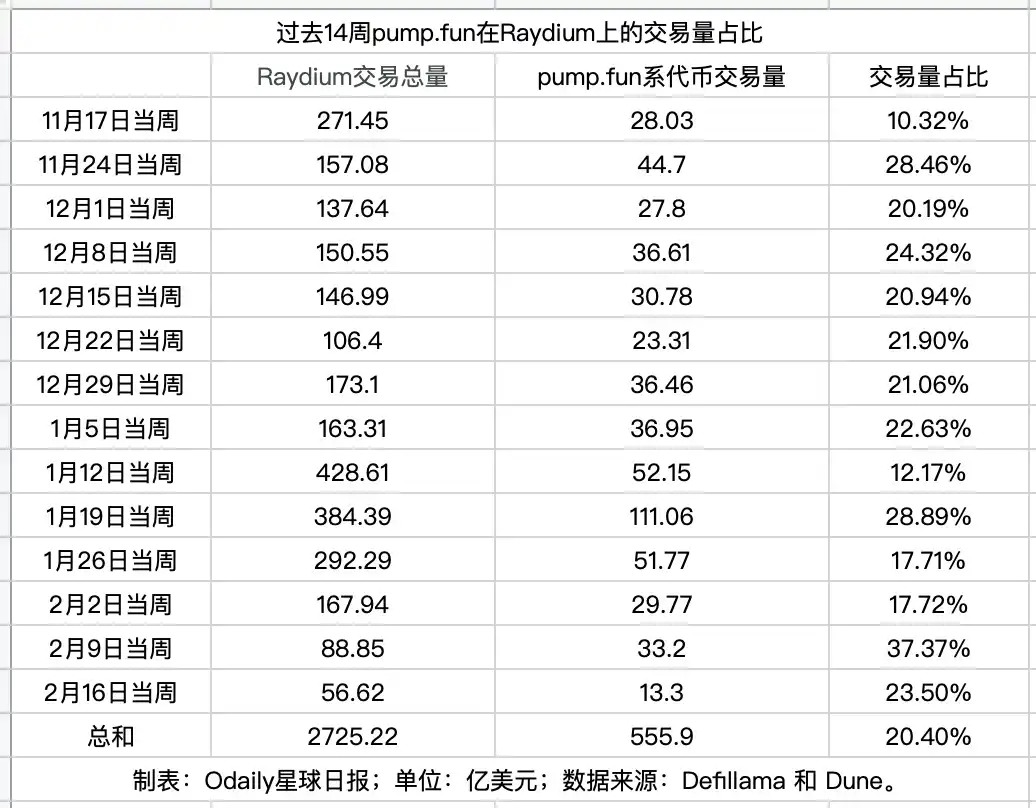
As can be seen from the above chart, in the past 14 weeks, the trading volume of the pump.fun token on Raydium has generally accounted for around 20%. This means that if pump.fun does indeed redirect trading volume from Raydium in the future through its own AMM (excluding autonomous liquidity migration activities due to uncertain platform fee rate differences), Raydium is expected to experience around a 20% reduction in trading volume.
Oversold?
Turning back to the market situation, OKX data shows that RAY dropped to a low of $2.82 today, corresponding to a decrease of over 30% (the data was delayed, but in hindsight, there was indeed some overselling at that time). The current price has gradually recovered to $3.15, representing a 25.43% decrease.
Considering that SOL also experienced a 5.8% decrease, RAY's current decline is basically within a reasonable range, meaning that the market has preemptively priced in pump.fun's frontrunning behavior.
Let's end with a quote from Fluid COO DMH:
“RAY's plummet once again proves to us that ‘distribution >>> tech.’ Both the traditional world (Microsoft) and the crypto space (Metamask) have countless examples showing that if you have a large enough user base, your product isn't that important.”
You may also like

The pricing controversy of Trade.xyz exposes the fatal weakness of Pre-IPO perpetual contracts

World Cup 2026 Coming – WEEX Celebrates with $1M Prize Pool & Michael Owen Live

Galaxy in-depth report: Is Solana still worth paying attention to?
Young people in South Korea make a "final effort" in the epic bull market

Dialogue with OmenX Founder: Why does the prediction market need an evolution from "spot" to "derivatives"?
When the P2P illicit funds from ten years ago turned into 60,000 bitcoins

Morning News | CME Group launches Nasdaq Cryptocurrency Index futures; Asset management giant Janus Henderson strategically invests in Ethena

Why did Oracle deliver the strongest financial report in history, yet its stock price fell?

Bitcoin Layer 2 Network Botanix: Why Did We Choose to Dissolve?

Morning Report | OpenAI has submitted an S-1 registration statement draft to the U.S. SEC; Morpho completes $175 million financing

Galaxy Deep Research Report: How Hyperliquid's HIP-4 Upgrade Changes the Landscape of Prediction Markets?

Latest research from 13 top universities including Cornell University: The current state, challenges, and misconceptions of the fusion of Crypto and AI
Deconstructing Anthropic: The Best AI Company, Possibly Also a Type of Organizational Invention

Every exchange is a "Universal Exchange."

The counterattack of traditional finance: Alliance chains are quietly reviving
Pantera Capital Partner: How Tokenization is Restructuring the Private Equity and Early Investment Ecosystem?

Mastercard Launches Agent Pay for AI, Plans to Record AI Agent Payment Authorizations on Polygon
Mastercard launched Agent Pay for AI, a new payment protocol designed to help AI agents make small payments such as pay-per-use access to data and APIs. The system plans to record human-granted AI agent permissions on Polygon, focusing on verifiable authorization, identity, and payment controls.

Curve Deploys Llamalend v2 on Optimism With 250,000 OP Incentives
Curve launched Llamalend v2 on Optimism with 250,000 OP incentives from the Optimism Foundation. The upgrade expands Llamalend beyond its earlier crvUSD-focused model, adding broader collateral support, LlamaRisk market reviews, and the ability to use Curve LP tokens as collateral.
The pricing controversy of Trade.xyz exposes the fatal weakness of Pre-IPO perpetual contracts
World Cup 2026 Coming – WEEX Celebrates with $1M Prize Pool & Michael Owen Live
Galaxy in-depth report: Is Solana still worth paying attention to?
Young people in South Korea make a "final effort" in the epic bull market
Dialogue with OmenX Founder: Why does the prediction market need an evolution from "spot" to "derivatives"?
When the P2P illicit funds from ten years ago turned into 60,000 bitcoins


