
From an RPC Perspective, How Do the Top Four Public Blockchains Compare in Terms of Cost-Effectiveness: BTC, SOL, BNB, and ETH?

Original Author: Murphy, On-chain Data Analyst
——You don't know how bad it is until you compare it to something else
The Realized Price (RPC) is a concept frequently used in on-chain data. Before understanding RPC, one must first understand Realized Cap (RC). RC is the sum of all coins valued at their last move price.
RC excludes factors such as lost or long-term non-circulating coins, better reflecting the true stored value in the entire blockchain network;
Dividing RC by the current total circulating supply gives us RPC. The higher the price at which tokens are sold (moved), the more subsequent funding it implies, and vice versa. In other words, only continuous buying at high prices in actual gold and silver can raise RPC. Therefore, it is the most direct basis for observing capital inflows.
At the same time, RPC is also considered the average cost basis. Whenever a pullback occurs, RPC can play a significant support role. Once the price falls below RPC, it means the average position is at a loss. At this point, the asset price is "undervalued," attracting more bottom-fishing funds when the risk-to-reward ratio appears, gradually forming a bottom range.
· BTC
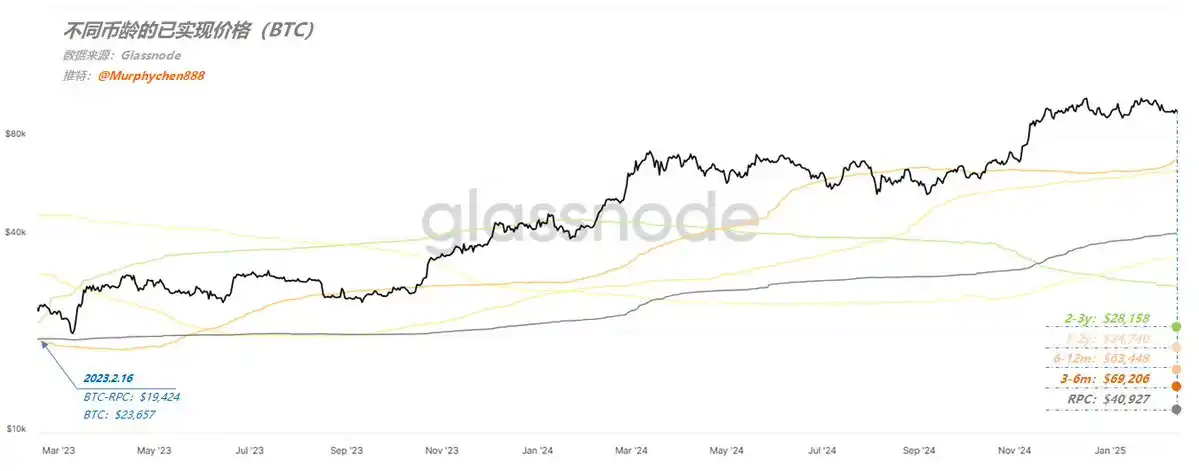
Figure 1 shows the RPC data for BTC at different coin ages (holding times). It can be seen that among the four Long-Term Holder (LTH) groups, the longer the time held, the lower the average cost. The cost for 3-6 months (3-6m) is $69,200; for 2-3 years (2-3y) the cost is $28,158; in other words, even if one day BTC falls back to $30,000 during a bear market, these LTH groups are still profitable.
(Figure 1)
As of February 13th, BTC's RPC is $40,927, based on the current price of $96,600, investors still have an average of 136% unrealized gains, providing an excellent holding experience! Therefore, whenever BTC's price fluctuates, there is little panic selling pressure, and no chain reaction is triggered. This is also one reason why BTC in this cycle "doesn't drop too deeply." With such a low RPC, it is clearly not a reference price to support during a bull market cycle correction, but it can serve as a judgment standard for the bottom phase of a bear market cycle.
On 2023.2.16, the RPC of BTC was $19,424, a 210% increase over 2 years; during the same period, the price of BTC rose from $23,600 to $96,600, a 409% increase. The price increase far exceeded the increase in absorbed capital, indicating that in addition to capital, BTC also attracted more mainstream sentiment value (high market attention).
· SOL
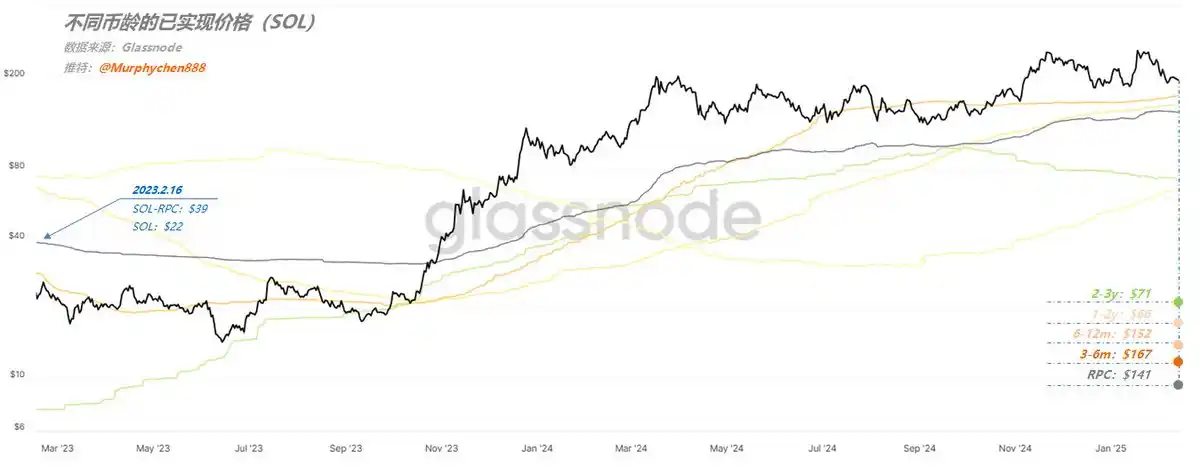
Figure 2 shows the RPC data for SOL at different coin ages. In the past 2 years, SOL investors have had a very positive holding experience. It can be seen that the average cost of all long-term coin-holding groups is lower than the current SOL price. The cost for 3-6 months is $167, and for 2-3 years, it is $71;
(Figure 2)
As of February 13, SOL's RPC was $141; based on the current price of $194, investors still have an average of 37% unrealized gains. From this point of view, the stability of the SOL chip structure is far inferior to that of BTC. However, conversely, $141 is also a very strong support level. As long as there is a bull market consensus, the closer it is to this line, the weaker the selling pressure and the stronger the bottom-fishing sentiment.
On 2023.2.16, SOL's RPC was $39, making it the only mainstream coin at that time with a spot price lower than the RPC. In other words, SOL at this time was one of the most undervalued among several mainstream coins, offering the best cost-performance ratio. Over the course of 2 years, the RPC increased by 361%; during the same period, the price of SOL rose from $22 to $195, an 886% increase. Once again, the price increase far exceeded the increase in absorbed capital (better than BTC), indicating that in this cycle, SOL has also gained very high market attention.
· BNB
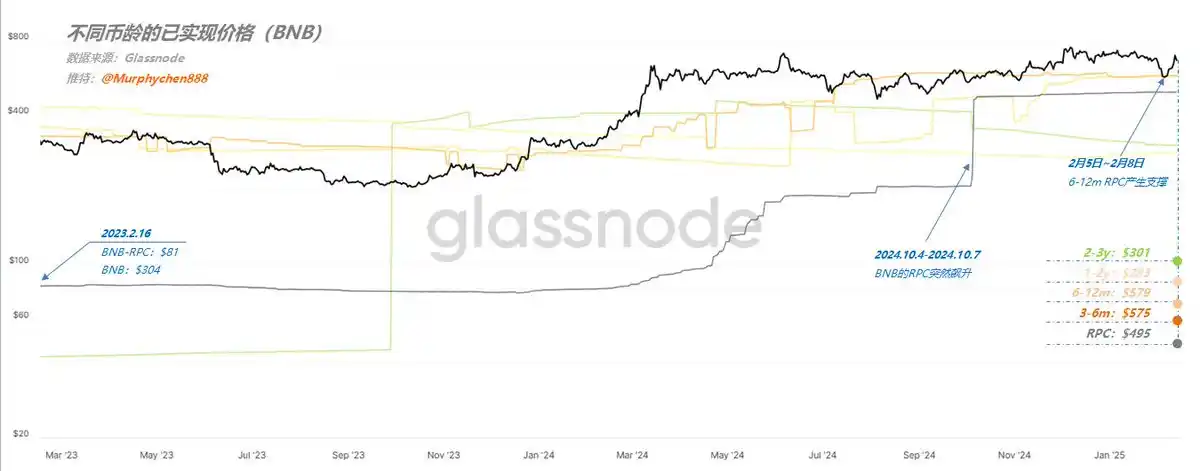
Figure 3 shows the RPC data for BNB at different coin ages. As the only token empowered by Binance and BNB Chain, it is truly deserving of the word "mainstream." Therefore, let's also look at its data performance.
(Figure 3)
The cost of 3-6m is $575, and the cost of 2-3y is $301; similarly, the average cost of all long-term holders must be below the current BNB price. There is a detail that, from February 5th to February 8th, BNB's price dropped to around $570 right at the support of the 6-12m RPC line, and then started to rebound.
As of February 13th, BNB's RPC is $495; based on the current price of $665, investors still have an average of 34% unrealized gains. However, we can observe that between October 4, 2024, and October 7, 2024, BNB's RPC suddenly surged from $206 to $463.
This data is very unusual and rarely seen in other mainstream coins with relatively evenly distributed chips. It also indirectly reflects the uniqueness of BNB's chip distribution. Only when a large number of chips reaching a certain circulation percentage suddenly move at a high level will it cause an abnormal RPC. Therefore, whether the current RPC of $495 can provide support is currently difficult to evaluate (the data may be interfered with).
On February 16, 2023, BNB's RPC was $81, which was much lower than the spot price of BNB at the time, $304; therefore, in terms of cost-effectiveness at that time, it was not as good as SOL or BTC. However, if the benefits of holding BNB such as Launchpool, Megadrop, and HODLer rewards are taken into account, the situation might be different.
· ETH
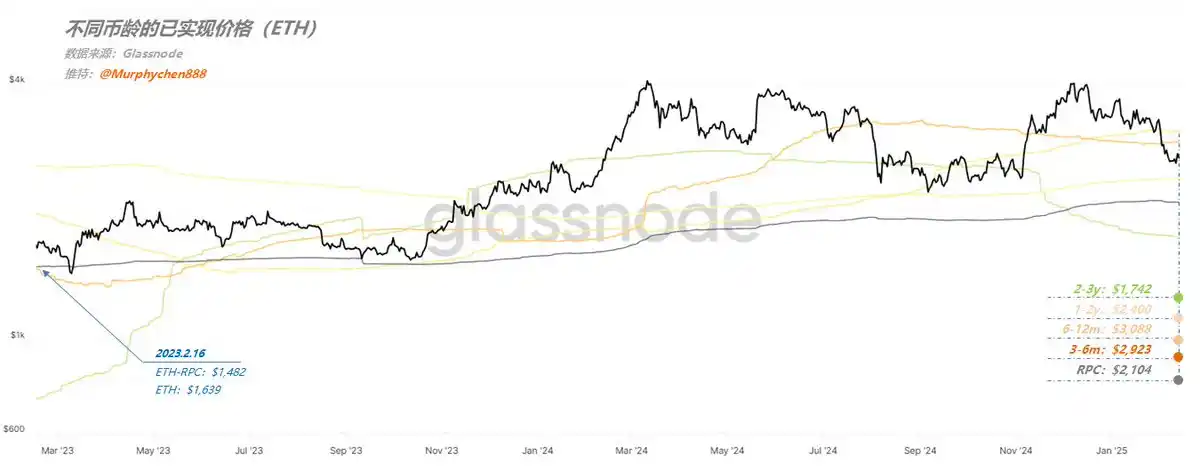
Figure 4 shows the RPC data of ETH at different coin ages. I placed ETH's data last because its data performance is the least favorable compared to the previous three.
(Figure 4)
The cost of 3-6m is $2,923, and the cost of 6-12m is $3,088; in other words, ETH is currently the only mainstream coin where investors holding for 12 months are still on average at a loss.
As of February 13th, ETH's RPC is $2,104, which coincides with the strong support formed at the lowest point on February 3rd (after the sharp drop). Based on the current price of $2,700, investors only have an average unrealized gain of 24%. This percentage is lower than both SOL and BNB, and significantly lower than BTC.
On February 16, 2023, ETH's RPC was $1,482; with a growth of 142% in two years; during the same period, ETH's price increased from $1,639 to $2,700, a growth of 164%. The price increase is almost the same as the increase in absorbed capital, indicating that in this cycle, ETH has the lowest emotional value. Or, compared to BTC and SOL, the market's expectation value for ETH is the lowest.
-----------------------------------------
· Summary
1. In terms of the stability of the chip structure, BTC is much better than other mainstream coins. The long-term holding group currently has an average of 136% unrealized gains. SOL and BNB are similar, at 37% and 34% respectively; ETH is the lowest, at only 24%. This means that the current spot price of ETH is closest to the average cost basis, and ETH holders have the worst holding experience. Once the price falls below this support level, it could easily trigger a chain reaction.
2. Comparing the price increase and capital absorption increase in the past 2 years, BTC and SOL have received more emotional hype, or higher expectations.
3. Due to abnormal RPC data for BNB generated in October 2024, the current RPC cannot determine if it has been tampered with. If not, then the current BNB holders also have a very good holding experience. At the same time, holding BNB allows for additional monthly mining rewards or airdrop benefits, which is a plus.
4. Lastly, there is ETH... How should I evaluate ETH? As one of the only two crypto assets approved through an ETF, it is high quality. However, various performances of the Ethereum Foundation leave much to be desired. Vitalik, as the founder, is undoubtedly a brilliant developer, but at the moment, he may not be a qualified leader.
PS: If anyone is interested in knowing the RPC support level data for other coins, you can leave a comment in the comment section. If I can find it, I will reply one by one.
-----------------------------------------
My sharing is for learning and communication purposes only, not as investment advice
You may also like

Mastercard Launches Agent Pay for AI, Plans to Record AI Agent Payment Authorizations on Polygon
Mastercard launched Agent Pay for AI, a new payment protocol designed to help AI agents make small payments such as pay-per-use access to data and APIs. The system plans to record human-granted AI agent permissions on Polygon, focusing on verifiable authorization, identity, and payment controls.

Curve Deploys Llamalend v2 on Optimism With 250,000 OP Incentives
Curve launched Llamalend v2 on Optimism with 250,000 OP incentives from the Optimism Foundation. The upgrade expands Llamalend beyond its earlier crvUSD-focused model, adding broader collateral support, LlamaRisk market reviews, and the ability to use Curve LP tokens as collateral.

Raydium Old Liquidity Pool Reportedly Exploited, With $1.34 Million Moved to Ethereum and Tornado Cash
An old Raydium liquidity pool was reportedly exploited for around $1.34 million in USDC, RAY, and wSOL, with the stolen funds bridged to Ethereum and deposited into Tornado Cash. The incident highlights the tail risks of legacy DeFi pools, old contracts, and cross-chain fund laundering paths.

Kalshi Executive Challenges “SBF Backed AI Unicorns” Narrative, Says Leopold Aschenbrenner Was Key Figure
Kalshi executive John Wang questioned the “SBF backed AI unicorns” narrative, saying Leopold Aschenbrenner was the key figure behind major AI investment decisions.

Pantera Capital Partner: How Tokenization is Restructuring the Private Equity and Early Investment Ecosystem?

New York Proposes Stricter Stablecoin Issuer Rules Aligned With Federal GENIUS Act
NYDFS proposed stricter stablecoin issuer rules aligned with the GENIUS Act, covering reserves, custody, redemption timelines, audits, and capital buffers.
Every exchange is a "Universal Exchange."

The counterattack of traditional finance: Alliance chains are quietly reviving

CryptoQuant Says Bitcoin Profitable Supply Is Near 45% Pressure Zone as On-Chain Data Points to Market Repricing
CryptoQuant said Bitcoin’s profitable supply is nearing the 45% pressure zone, signaling rising market stress, unrealized losses, and a possible on-chain repricing phase.

Bitcoin Falls Below 200-Week Moving Average as On-Chain Data Shows Over Half of Supply in Loss
Bitcoin dropped below its 200-week moving average as on-chain data showed over 50% of circulating supply is now in loss, signaling rising market stress.

CFTC Reportedly Plans New Prediction Market Rules Focused on Manipulation Risk and Public Interest Review
The CFTC is reportedly preparing new prediction market rules focused on manipulation risk, public interest review, and retail trader protections.

Meet the new WEEX trial fund—your gateway to greater profits

WEEX Labs Lands at Dutch Blockchain Week: A Disruptive Crypto × AI Conversation Sets Sail in Amsterdam
SK Hynix Reportedly Plans U.S. ADR Listing as Early as August, With SEC Approval Possible in Late June
SK Hynix may pursue a U.S. ADR listing as early as August, with SEC approval reportedly possible in late June amid strong AI chip supply chain demand.

SpaceX vs Tesla vs xAI: Which Elon Musk Trade Has the Biggest Upside in 2026?
OpenAI Reveals It Has Confidentially Submitted an S-1 to the SEC, Keeping the Door Open for a Future IPO
On June 9, according to an OpenAI announcement, the company recently confidentially submitted a draft S-1 registration statement to the U.S. Securities and Exchange Commission (SEC), beginning the preliminary compliance process for a potential initial public offering. OpenAI said it chose to disclose this proactively because it expected the news might leak; however, the company has not yet set a specific listing timeline, and related arrangements may still take some time.
Latest research from 13 top universities including Cornell University: The current state, challenges, and misconceptions of the fusion of Crypto and AI
Deconstructing Anthropic: The Best AI Company, Possibly Also a Type of Organizational Invention
Mastercard Launches Agent Pay for AI, Plans to Record AI Agent Payment Authorizations on Polygon
Mastercard launched Agent Pay for AI, a new payment protocol designed to help AI agents make small payments such as pay-per-use access to data and APIs. The system plans to record human-granted AI agent permissions on Polygon, focusing on verifiable authorization, identity, and payment controls.
Curve Deploys Llamalend v2 on Optimism With 250,000 OP Incentives
Curve launched Llamalend v2 on Optimism with 250,000 OP incentives from the Optimism Foundation. The upgrade expands Llamalend beyond its earlier crvUSD-focused model, adding broader collateral support, LlamaRisk market reviews, and the ability to use Curve LP tokens as collateral.
Raydium Old Liquidity Pool Reportedly Exploited, With $1.34 Million Moved to Ethereum and Tornado Cash
An old Raydium liquidity pool was reportedly exploited for around $1.34 million in USDC, RAY, and wSOL, with the stolen funds bridged to Ethereum and deposited into Tornado Cash. The incident highlights the tail risks of legacy DeFi pools, old contracts, and cross-chain fund laundering paths.
Kalshi Executive Challenges “SBF Backed AI Unicorns” Narrative, Says Leopold Aschenbrenner Was Key Figure
Kalshi executive John Wang questioned the “SBF backed AI unicorns” narrative, saying Leopold Aschenbrenner was the key figure behind major AI investment decisions.
Pantera Capital Partner: How Tokenization is Restructuring the Private Equity and Early Investment Ecosystem?
New York Proposes Stricter Stablecoin Issuer Rules Aligned With Federal GENIUS Act
NYDFS proposed stricter stablecoin issuer rules aligned with the GENIUS Act, covering reserves, custody, redemption timelines, audits, and capital buffers.

Popular coins
Latest Crypto News


