
OpenAI and Anthropic, both pre-IPO, want to keep brawling


Author | Kaori
Editor | Sleepy.md
The conflict between OpenAI and Anthropic will not cease, for it cannot.
Anthropic needs an insecure adversary to prove the necessity of a secure narrative, while OpenAI needs a hypocritical adversary to prove the legitimacy of an open narrative. This structure dictates that the existence of the other is the best advertising material for oneself, with each round of attack reinforcing the motivation for the next round of attack.
Both companies are simultaneously rushing towards an IPO window, and this mutual brawl also serves a more practical function, which is to preemptively define their valuation logic in the minds of investors. Whose narrative is more legitimate will secure a higher valuation.
In early April, OpenAI's Chief Revenue Officer, Denise Dresser, sent an internal memo to all employees, which is essentially a product of this logic. Because this memo was not intended for the eyes of the employees.
Dresser dedicated an entire section in the memo to launch a point-by-point attack on Anthropic: their brand narrative is built on fear, restriction, and AI control by a few elites; a strategic error in computing power has led to product throttling and degraded user experience; and Anthropic's externally claimed $30 billion in annual revenue is overestimated by about $8 billion because it accounts for revenue sharing with Amazon and Google on a gross basis, while OpenAI uses a net basis for its sharing with Microsoft.
A company's Chief Revenue Officer devoting a section in an internal memo to dissect a competitor's accounting practices is almost unprecedented in the tech industry's internal communications.
$8 Billion Accounting Accusation
This memo reached Bloomberg and The Verge reporters within a day. Just a week before, OpenAI had separately sent another memo to investors, stating that Anthropic is operating on a smaller growth trajectory.
$8 billion, the core of this accusation lies in an accounting term.
When Anthropic distributes Claude through AWS and Google Cloud, the total amount customers pay to the cloud platforms is recorded as Anthropic's revenue, with the commission paid to the platforms treated as a cost, following the gross method. OpenAI, on the other hand, uses the net method for its revenue sharing with Microsoft, only recording the part they actually receive.
Both treatment approaches are legal under US Generally Accepted Accounting Principles. Anthropic's reasoning is that it acts as the principal in transactions, with the cloud platform merely serving as a distribution channel. OpenAI's counterargument is that the net method is the standard that public companies are required to follow.
Both sides have valid points, but validity is not the focus—the focus is on the outcome.
If recalculated on a net basis, Anthropic's comparable revenue drops from $30 billion to $22 billion, conveniently aligning with OpenAI's self-reported $25 billion.
During the IPO sprint window for both companies, whichever has the larger revenue figure will directly determine their ranking in investors' minds.
Anthropic's revenue sits at $9 billion by the end of 2025, skyrocketing to $30 billion by March 2026, with a growth rate over three times that of OpenAI. If this momentum takes root in investors' minds, OpenAI's $850 billion valuation will face a critical question: why are you twice as expensive as the other, yet growing at a third of the speed?
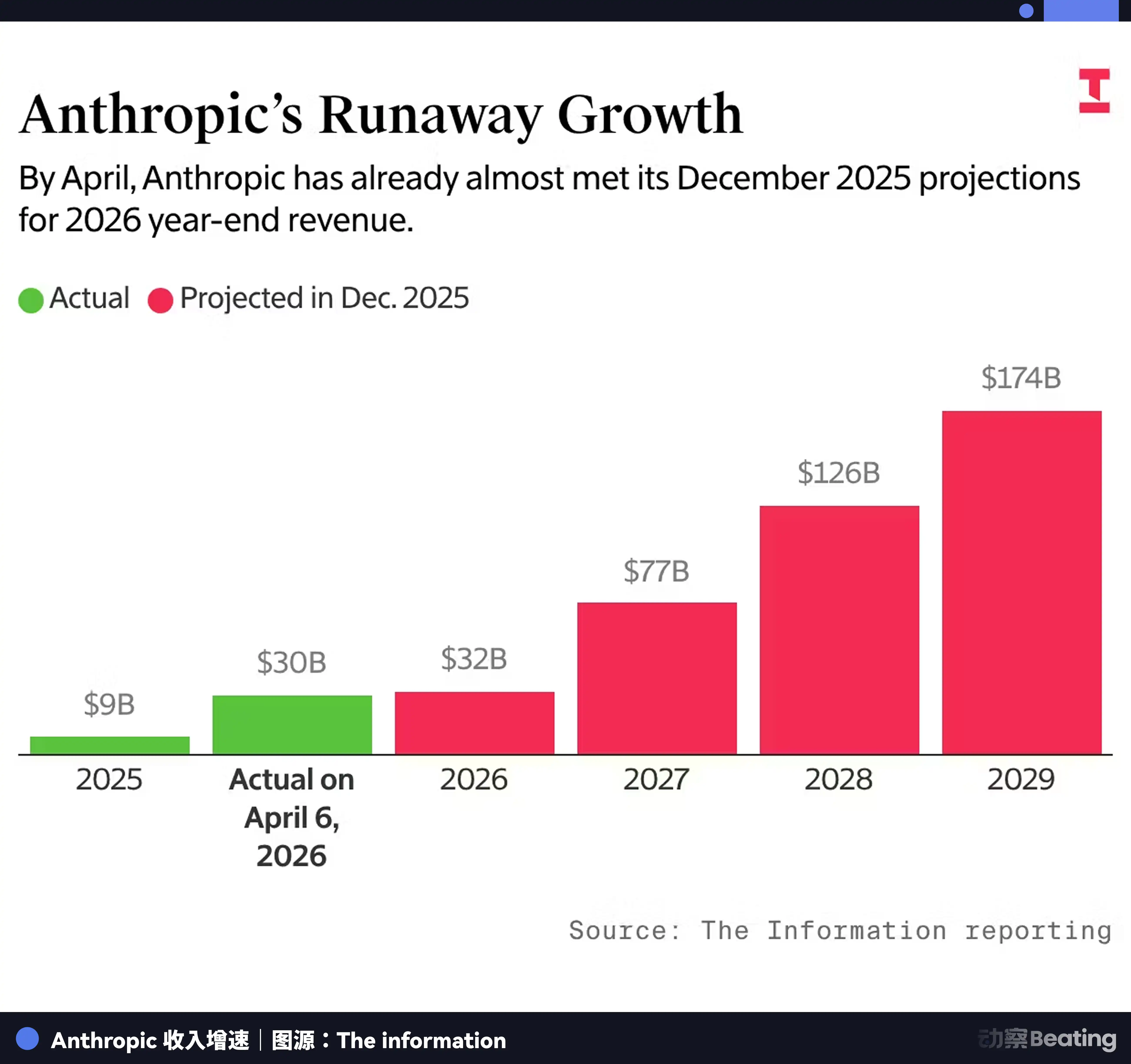
Therefore, Dresser's $8 billion accusation serves only one purpose: to subconsciously implant in investors the idea that Anthropic's figures cannot be taken at face value.
However, this attack has an ironic twist, as Dresser heavily promotes OpenAI's new partnership with Amazon in the same letter. If OpenAI significantly moves towards distribution through the Bedrock channel in the future, it too will face the same gross and net issues.
The whip used to lash others today may fall on oneself tomorrow.
The accounting method dispute is just the most quantifiable part of this letter. What is more worthy of analysis is Dresser's qualitative judgment on the essence of the Anthropic brand.
Fear or Responsibility
"Their narrative is built on fear, restriction, and the idea that a select few elites should control AI."
Most reports take this statement as an insult, but it is more than just an insult.
Dresser is repricing. She attempts to make investors view Anthropic's security brand premium as a form of artificially created scarcity, a packaged form of differentiation.
On April 7th, Anthropic announced its most powerful model to date, Claude Mythos Preview, while also announcing the non-public release of this model. In its place is a restrictive access program, Project Glasswing, allowing 12 core partners to use Mythos to scan and repair zero-day vulnerabilities in critical software.
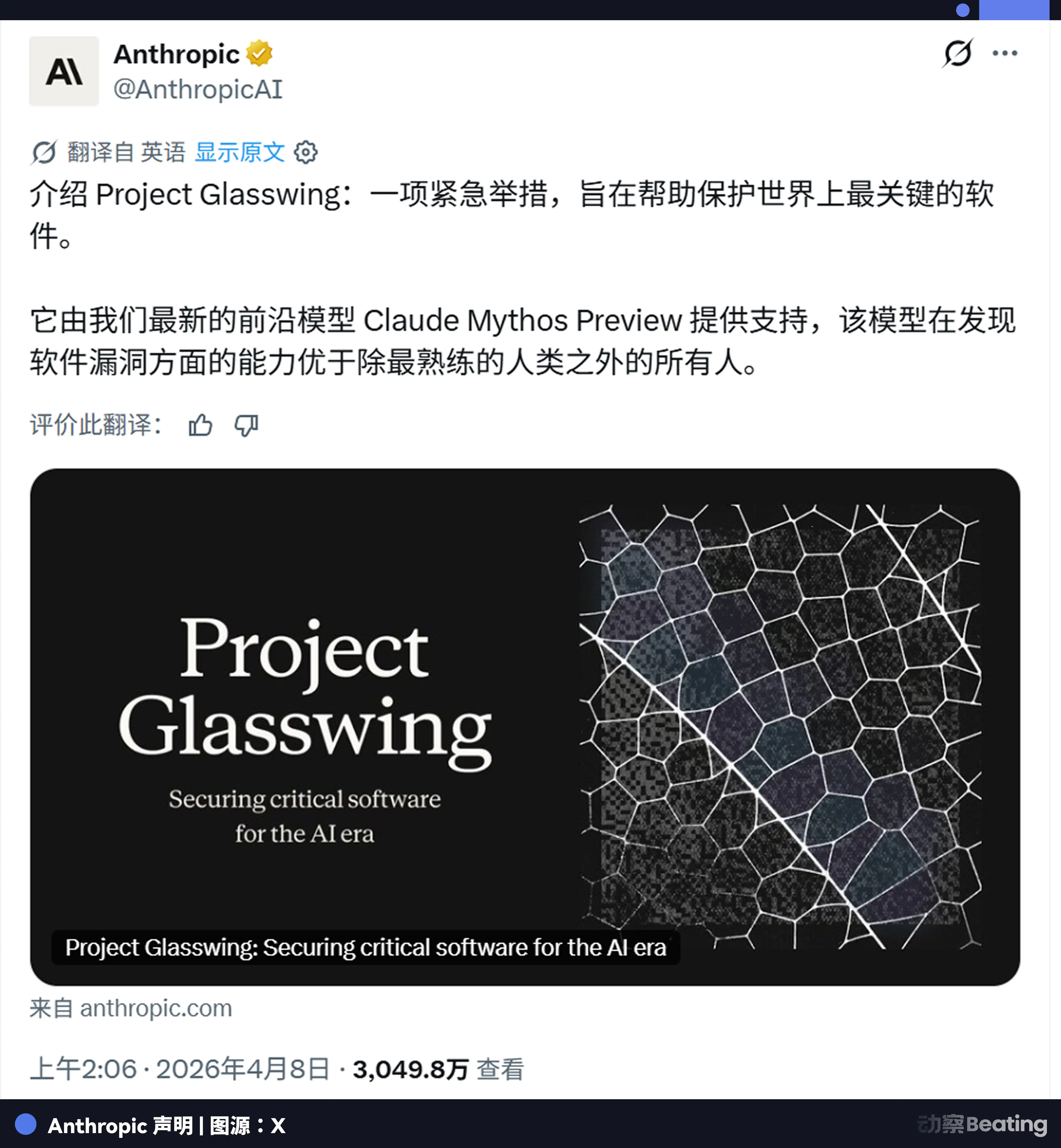
Anthropic claims that Mythos has discovered thousands of critical vulnerabilities in every mainstream operating system and browser over the past few weeks, including a FreeBSD remote code execution vulnerability that has existed for 17 years.
A powerful model too sensitive to be publicly disclosed, restricted to a few elite organizations to safeguard global cybersecurity, this is the pinnacle form of Anthropic's security narrative.
While some researchers have noted that some security companies have been able to replicate parts of Mythos's findings using older, cheaper, publicly available models, Anthropic has framed the act of bridging the discovery-to-exploitation chain as a watershed moment, using it as a reason to lock in product release cadence.
In OpenAI's narrative framework, Glasswing is the epitome of elite-controlled AI. You have a powerful tool that you don't let most people use, citing security reasons, but the net effect is that only those you trust can access this capability.
Within Anthropic's narrative framework, Glasswing is the ultimate proof of responsible AI development. We are powerful enough to discover vulnerabilities others can't, yet restrained enough not to throw this capability directly into the market.
Both narratives serve their respective IPO valuation models.
Anthropic needs investors to believe that the security brand premium is sustainable. OpenAI needs investors to believe that scale and compute power are the ultimate moats.
Who fired the first shot?
This is a seemingly simple yet unanswerable question.
Because there is too much evidence, and each piece can be interpreted by each side as the other striking first.
If you take Dario Amodei's perspective, the starting point is the internal governance collapse at OpenAI. In 2017, he witnessed Musk-driven brutal layoffs, and in 2018, after Altman took over, he was promised governance limits on Brockman and Sutskever, but at the same time, the latter two were given contradictory assurances. In 2020, Altman directly accused the Amodei siblings of secretly feeding unfavorable feedback to the board, only to later deny ever saying such a thing when confronted.
These experiences have cultivated a deep-seated distrust.
If you stand in Altman's shoes, the starting point is Dario's departure style. In late 2020, Dario took away nearly ten core colleagues to establish Anthropic, categorizing the AI company into market-driven and public-interest-driven in his resignation memo. In this brand positioning manifesto, it preemptively placed OpenAI into the ethically inferior category. Subsequently, every public statement from Anthropic, from billboards on the streets of San Francisco to Super Bowl ads, has reinforced this classification.
The entanglement and feud between the two individuals and their respective companies can be traced back to the founding of OpenAI in 2015. Every step along the way, someone made a somewhat justifiable choice, culminating in an irreversible rupture.
It doesn't matter who struck first; what matters is why this hostility can't stop and why each conflict further reinforces itself.
The answer lies in brand architecture.
Once Anthropic positioned itself as the righteous side that departed due to security concerns, OpenAI automatically turned into the problematic side that was left behind. Once OpenAI characterized Anthropic as an elitist fearmonger, every cautious move by Anthropic became evidence of this accusation.
Both brands are diametrically opposed, meaning the other's existence itself is the best advertising material for their own brand.
Anthropic needs an insecure adversary to prove the necessity of the security narrative. OpenAI needs a hypocritical adversary to prove the legitimacy of the open narrative.
This is a Nash equilibrium, where neither side has an incentive to cease hostilities because a ceasefire would be more damaging to their respective brands than continued brawling.
Every round of upgrades in 2026 perfectly affirmed this structure.
In February, during the Super Bowl, Anthropic ran four ads, each starting with the words betrayal, deceit, treachery, infringement plastered across the screen, mocking OpenAI's decision to insert ads into ChatGPT. The ads concluded with the line, "Ads are entering AI, but they are not entering Claude."
Altman responded on X with a 420-word rebuttal, starting by acknowledging the ads were amusing and making references to dishonesty, Anthropic-style doublespeak, and selling expensive products to the rich.
New York University marketing professor Scott Galloway commented that when you are a market leader, you should never mention your competitor's name; Hertz never mentions Avis, Coca-Cola never mentions Pepsi. Altman's response itself was a sign of weakness.
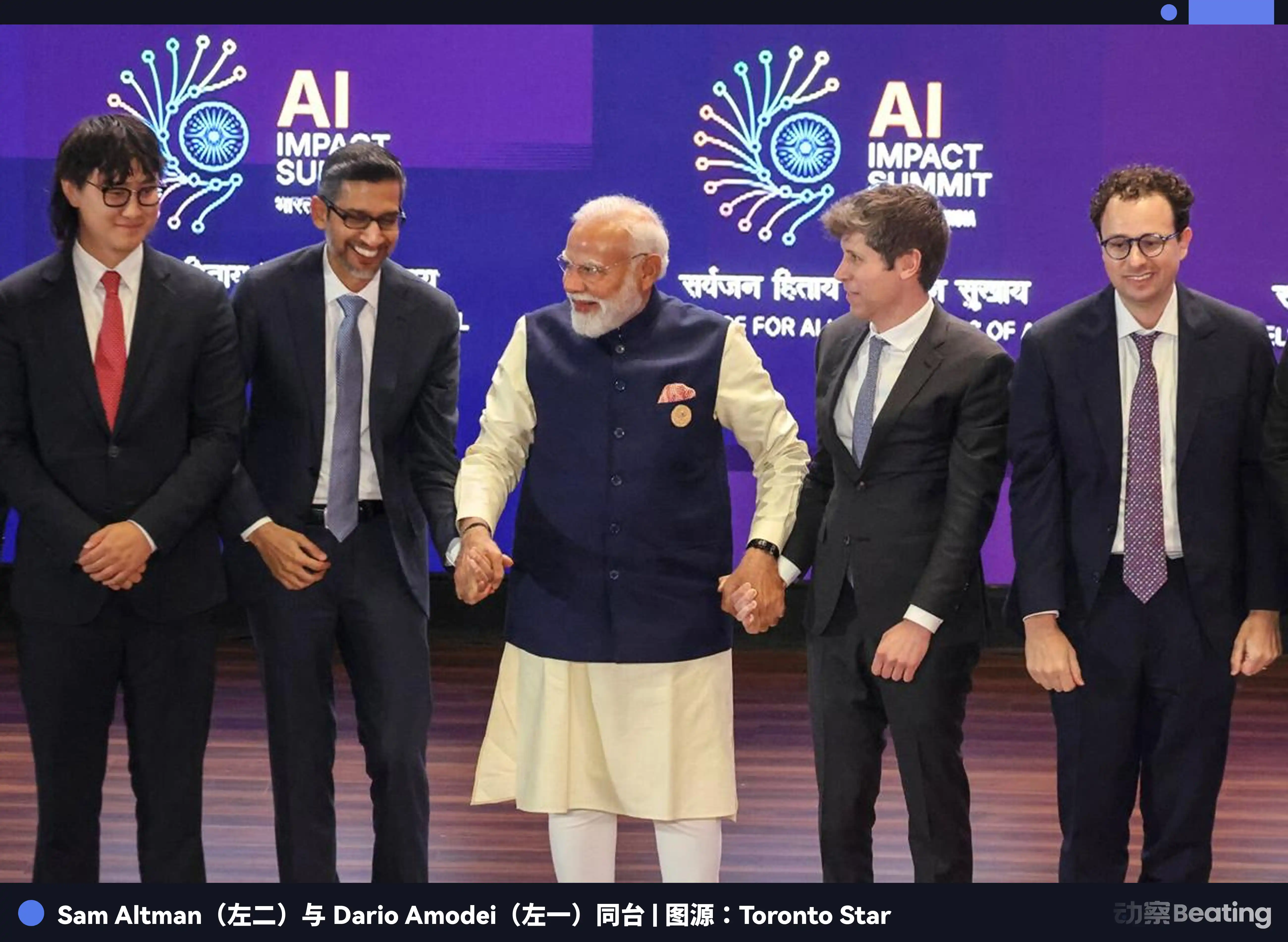
At the New Delhi AI Summit on February 19, Modi invited thirteen tech leaders on stage to join hands for a group photo. Everyone complied except for Altman and Dario, who stood next to each other. The two raised their fists without any physical contact, and the image went viral on social media. Altman later said he didn't know what had happened, while Dario made no public comment.
Later that month, a dispute erupted at the Pentagon. Anthropic refused to remove two exceptions from a contract and was promptly blacklisted by federal agencies. Hours later, OpenAI announced a partnership with the Pentagon. A judge ruled in March that the Pentagon's actions amounted to unconstitutional retaliation, briefly propelling Claude to the number one spot on the App Store.
In the first week of April, Anthropic launched Mythos and Glasswing. In the second week of April, two memos from OpenAI were leaked consecutively. Each wave of attacks occurred at crucial junctures like fundraising rounds, product launches, or IPO preparations.
So, in this back-and-forth, tit-for-tat rhythm, who is coming out ahead?
The Winner Is not in the Arena
In the closing line of the letter, Dresser wrote what seemed like a mild statement: "Customers will benefit from the competition."
But on the eve of the IPO, it wasn't the customers who emerged as winners from this war of words; it was the investors. Beyond the investors, there was another group of quieter beneficiaries.
Amazon stands as the most prominent winner.
In the letter, Dresser bluntly mentioned how Microsoft's partnership restricted OpenAI's access to customers while also praising the demand for Amazon Bedrock. This implies that OpenAI is positioning Amazon as its second marriage, yet Anthropic's first marriage was also built on AWS.
Amazon invested $50 billion in OpenAI and is also one of Anthropic's major cloud partners. Regardless of who wins between the two, Amazon has a seat at the table.
What's more, Dresser's accusation of Anthropic's inflated revenue conveniently involves Amazon itself. If this accounting dispute is eventually arbitrated by the SEC during the IPO review, Amazon, as the other party in the deal, will hold the most critical pieces of evidence. It is the evidence in the referee's hands and the sponsor of each player on the field.
The second winner is Google.
While OpenAI and Anthropic define each other as reference points, Google does not fit into this binary narrative framework.
Gemini 3 surpassed ChatGPT 5.1 in an end-of-2025 benchmark test, but due to the media and investor attention drawn to the dramatic conflict between OpenAI and Anthropic, Google gained narrative freedom, allowing it to quietly advance its products without needing to imbue every action with a secure or open ethical implication.
The third winner is regulators.
OpenAI co-founder Greg Brockman personally donated $25 million to the pro-Trump MAGA committee while also raising over $125 million through a PAC co-launched with a16z, supporting federal unified oversight and opposing state-by-state legislation. Anthropic, on the other hand, donated $20 million to Public First Action, which advocates for strengthening AI regulation.
Both companies used political contributions to purchase their preferred regulatory environment.
Following the Pentagon dispute, Anthropic also hired lobbying firm Ballard Partners, closely tied to the Trump administration, a company that had previously turned down military contracts on security principles, now finding a way to the White House in Washington.
The more intense the feud, the higher the lobbying demand in Washington for both companies, and the stronger the bargaining power of regulators.
The final winner is IPO underwriters.
The conflict between the two companies spared investors the trouble of understanding technical differences. Do you believe in security-first? Buy Anthropic. Do you believe in scale-first? Buy OpenAI.
For the seller, this is the most effortless sales pitch. You don't need to make investors understand complex technical differences; you just need to ask them one question: Which side are you on?
A commercial competition encoded as a family feud no longer requires data to convince investors; it requires a stance.
All these winners have one thing in common: their interests do not depend on which company wins but on the continuation of the conflict. The more the two companies brawl, the higher Amazon's channel value, the heavier the regulatory stakes, and the better the story for underwriters to sell.
And neither party seems to intend to stop, because if they do, each of their valuation stories would lose the other half, which is the most dramatic part.
You may also like

Japan’s Three Megabanks Plan Joint Stablecoin Issuance in Fiscal 2026
MUFG, SMBC, and Mizuho reportedly plan to jointly issue fiat-pegged stablecoins in fiscal 2026, signaling Japan’s growing push into bank-led digital payment infrastructure.

Humanity Discloses H Token Dual-Chain Attack Details, With Losses on Ethereum and BSC Exceeding $36 Million
Humanity said the H token attack across Ethereum and BSC caused more than $36 million in losses after leaked ProxyAdmin keys enabled malicious contract upgrades and token minting.

White House Discusses CLARITY Act With Law Enforcement Ahead of Senate Vote
The White House discussed the CLARITY Act with law enforcement ahead of a Senate vote, focusing on illicit finance risks and developer protections.

$75 billion in foreign capital has fled, and South Korean retail investors have absorbed it all using leverage

Bitcoin Trading Guide 2026: Strategies for Experienced Traders

What Is XAUT and PAXG? Why Tokenized Gold Is Booming in 2026

Cryptocurrency CEXs are flocking to sell US stocks, and traditional brokerages are facing an "uninvited guest."

Will the SpaceX IPO Hurt Bitcoin? Here's What Traders Are Watching
Foreign selling in the South Korean stock market accelerates, with cumulative net sales reportedly reaching $75 billion this year
On June 9, The Kobeissi Letter, citing Goldman Sachs data, reported that global investors are selling South Korean stocks at an unusually rapid pace. In the latest trading session, foreign investors sold about $801 million worth of Kospi constituent stocks again; total foreign outflows last week reached about $10 billion, and the market has been in net foreign selling on nearly every trading day over the past month. According to the data cited in the report, foreign investors have sold about $75 billion worth of South Korean stocks so far this year. Meanwhile, South Korean retail and institutional investors together recorded roughly $69 billion in net buying over the same period, suggesting that the market’s main buying support has come from domestic capital rather than returning overseas funds. The information currently disclosed still mainly comes from The Kobeissi Letter’s retelling and Goldman Sachs data summaries, while public details on the statistical period and the specific definition of “selling” remain relatively limited.

Fortune Warns of Strategy’s Financing Structure Risks as Bitcoin Premium Narrows
Fortune warned that Strategy’s Bitcoin treasury model faces growing financing risks as MSTR’s net asset premium narrows and preferred stock dividend pressure increases.

Ferrari Challenge Le Mans: Carl Moon to Dominate in WEEX Livery

Sahara AI Responds to SAHARA’s Sharp Drop: No Contract or Product Security Issues Found, Internal Investigation Underway
Sahara AI responded to SAHARA’s 60% price drop, saying no token contract or product security issues have been found and an internal investigation is underway.

WEEX Deposit/Withdrawal Dynamic Island: Your Asset Status, Always in Sight
Scaling Crypto Derivatives: The Digital Asset Infrastructure Behind High-Volume Trading
In the fast-moving digital asset ecosystem, derivatives platforms face an extreme architectural test. High-leverage futures markets demand more than just standard security—they require absolute operational precision, zero-latency matching engines, and ironclad structural scalability, all while navigating intense market volatility.
As global platforms scale to meet these demands, the industry is shifting away from rigid, monolithic setups toward a more agile, "decoupled" infrastructure philosophy.
The Blueprint for High-Volume Copy TradingFor elite global exchanges like WEEX (founded in 2018), this architectural choice becomes critical when scaling high-volume retail features like social copy trading. When thousands of users automatically mirror the real-time strategies of elite traders simultaneously, it triggers sudden, monumental spikes in concurrent transactional volume.
To prevent execution latency or settlement bottlenecks during these peak volatility events, a platform's primary engine must remain entirely dedicated to risk management, copy-trade synchronization, and order matching.
The Architectural Rule: New-generation platforms must separate front-end user execution engines from heavy backend infrastructural overhead to eliminate operational friction.
By separating these layers, platforms can maintain complete sovereignty over their trading environments and user experiences while strategically aligning with institutional-grade infrastructure ecosystems. This strategic framework allows modern exchanges to leverage advanced Digital Asset Custody infrastructure such as Cobo’s behind the scenes, ensuring that backend wallet management scales elastically alongside trading spikes.
Capitalizing on Market Momentum and 400× LeverageIn a derivatives arena where platforms offer up to 400× leverage on perpetual contracts, capital efficiency and market agility are core business metrics. To capture market momentum, an exchange needs the ability to rapidly expand its asset offerings, supporting everything from legacy crypto assets to sudden, trending altcoins across a massive library of trading pairs.
Adopting a flexible, scalable Wallet-as-a-Service (WaaS) solution such as Cobo’s could completely rewrite the development timeline for high-growth exchanges. Instead of spending months of engineering capital building out custom backend wallet architectures for every new blockchain network, platforms can deploy localized infrastructure in days.
This agility allows platforms to instantly scale their listings to over a thousand trading pairs without compromising security or delaying time-to-market. It mirrors the exact operational advantages seen during high-velocity market events, similar to how advanced wallet infrastructure empowers platforms during sudden asset surges; allowing exchanges to pass that speed and liquidity directly to their global user base.
A Mature Foundation for GrowthThe synergy between trusted infrastructure ecosystems and global trading platforms represents the natural evolution of a maturing crypto market. As WEEX continues to scale its global spot and derivatives offerings for over 6 million users, adopting robust backend paradigms proves that platforms no longer have to compromise between cutting-edge trading velocity and uncompromised structural security.

Morning Report | BitMine increased its holdings by 126,971 ETH last week; trader Eugene announced his exit from the crypto market

Wang Chuan: How can one not feel anxious after the neighbor Old Wang made thirty times profit by investing in storage stocks? (Seven) - A quarter-century cycle

Get Paid to Onboard? Try WEEX’s New Homepage with Rewards for Registration, Deposit & Trade
WEEX Custom Layout: Build Your Perfect Trading Workspace in Seconds
Japan’s Three Megabanks Plan Joint Stablecoin Issuance in Fiscal 2026
MUFG, SMBC, and Mizuho reportedly plan to jointly issue fiat-pegged stablecoins in fiscal 2026, signaling Japan’s growing push into bank-led digital payment infrastructure.
Humanity Discloses H Token Dual-Chain Attack Details, With Losses on Ethereum and BSC Exceeding $36 Million
Humanity said the H token attack across Ethereum and BSC caused more than $36 million in losses after leaked ProxyAdmin keys enabled malicious contract upgrades and token minting.
White House Discusses CLARITY Act With Law Enforcement Ahead of Senate Vote
The White House discussed the CLARITY Act with law enforcement ahead of a Senate vote, focusing on illicit finance risks and developer protections.
$75 billion in foreign capital has fled, and South Korean retail investors have absorbed it all using leverage
Bitcoin Trading Guide 2026: Strategies for Experienced Traders
What Is XAUT and PAXG? Why Tokenized Gold Is Booming in 2026


