
X Launches Cashtag, Musk's Super App Most Concrete Landing

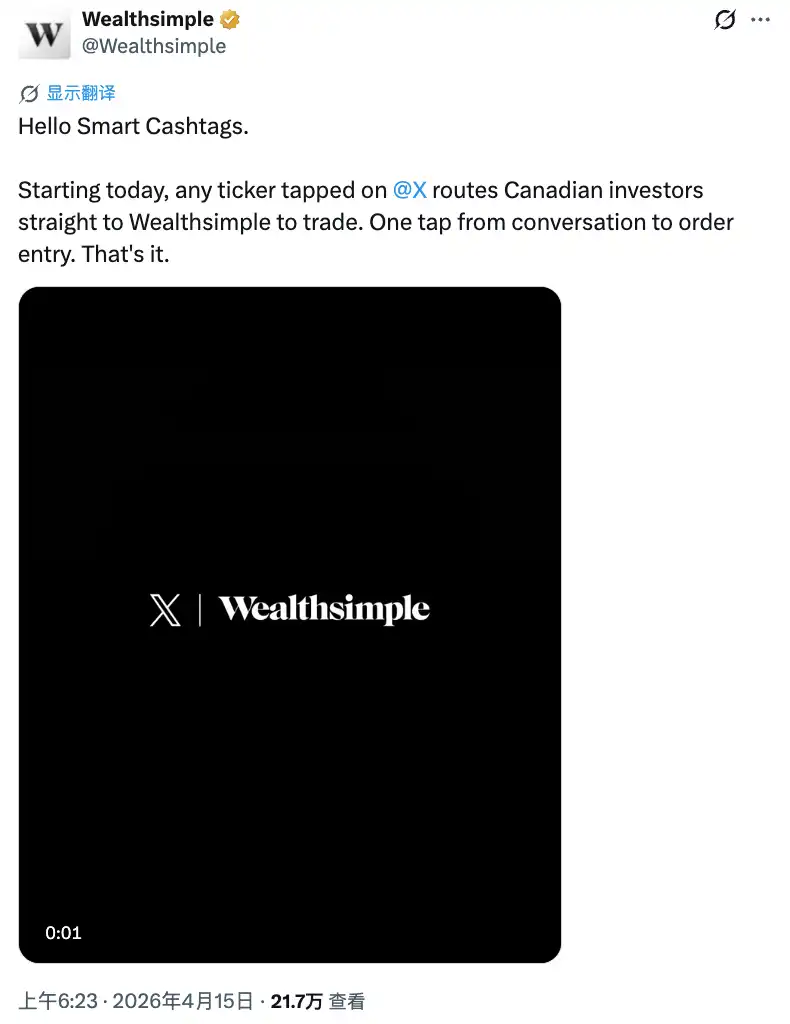
On April 14, X Platform launched the Cashtag feature on the iPhone in the United States and Canada. The usage is simple: typing $AAPL in a tweet turns this character string into a blue clickable link. Upon clicking, you will see Apple's real-time stock price chart, historical price trend, and all discussions related to $AAPL on X. If you are in Canada, you will also see a button to directly execute the trade on Wealthsimple.
What Can Cashtag Do?
It's not just about stocks. X's Cashtag also supports cryptocurrency. You can search for $BTC, $ETH, or directly enter the contract address of a Solana-based token to find its on-chain data. In other words, from mainstream blue-chip stocks to long-tail meme coins, this system aims to cover them all.
X's Product Manager Nikita Bier emphasized something during the feature release: X will not act as a broker and will not directly execute trades. X positions itself as a "data and discovery layer," responsible for presenting information, aggregating discussions, guiding users, with the actual order execution handled by third-party brokers.
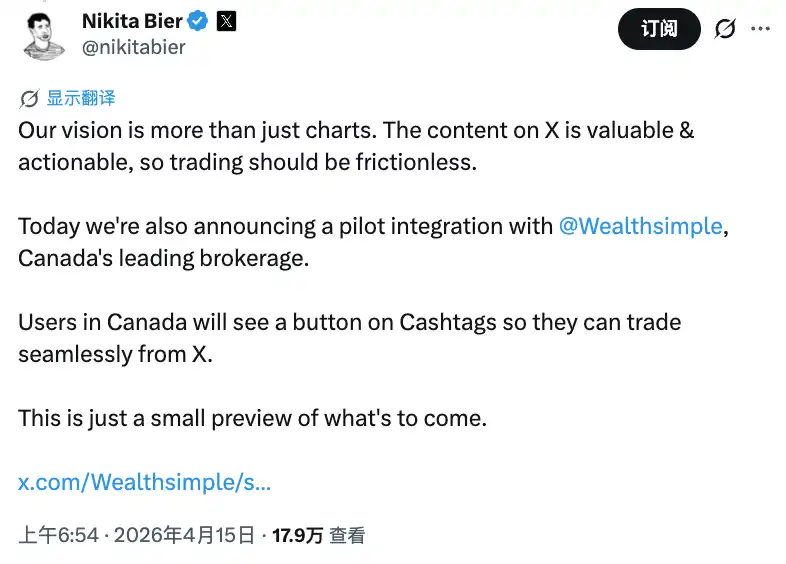
This positioning is crucial. If X were to act as a broker, it would need to undergo SEC broker-dealer license review, comply with FINRA requirements, and navigate a series of complex regulatory processes. By defining itself as a "data layer," where X only provides information display and trade execution happens elsewhere, the regulatory boundaries are much less defined.
However, from a user experience perspective, the entire path from seeing a tweet to completing a trade has been compressed into a few clicks. This is the first time on the X platform where there is no friction between discussion and action.
Its Origin Is Somewhat Ironic
The term "Cashtag" was not invented by X.
In 2008, a financial analyst and angel investor named Howard Lindzon created StockTwits, a social platform dedicated to serving investors. He introduced symbols like $AAPL, using $ at the beginning to turn stock tickers into clickable topic tags, allowing retail investors to discuss specific assets and track market sentiment. He gave this design a name: cashtag.
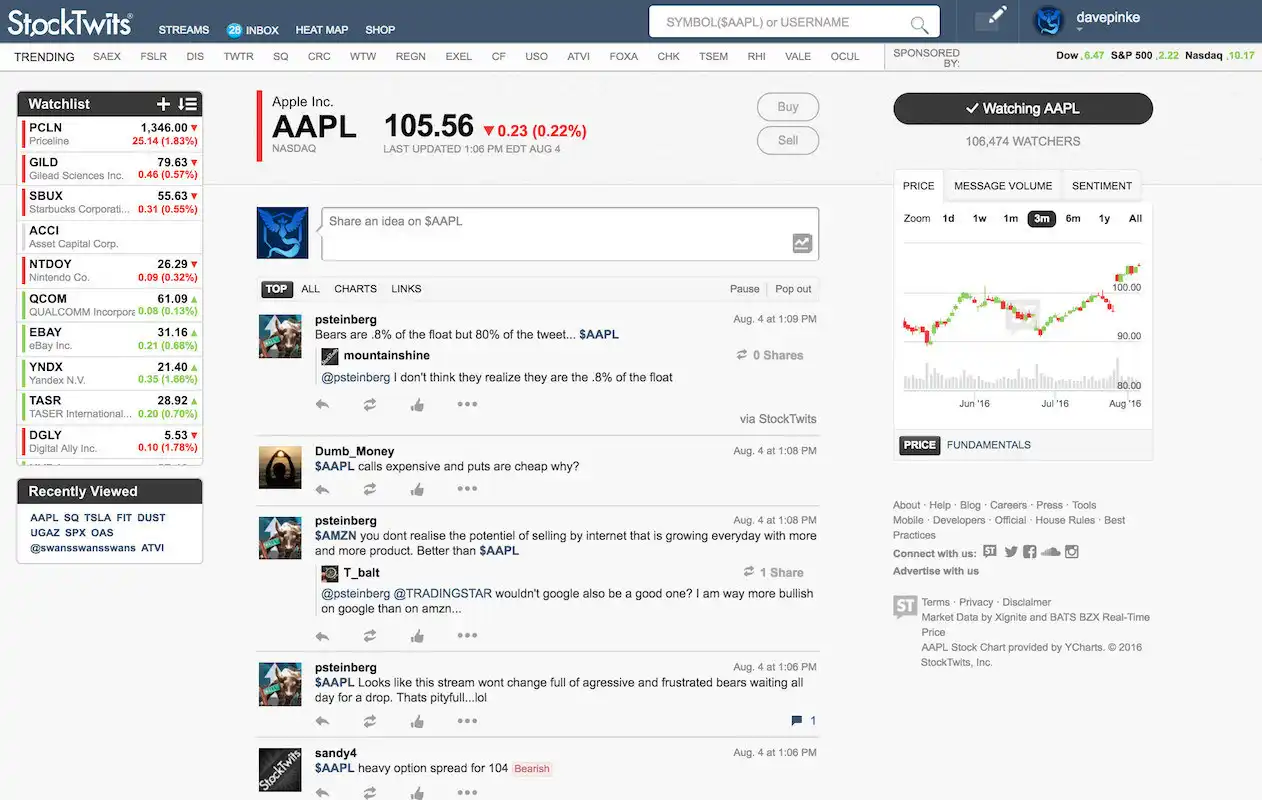
This idea has been circulating in a small circle for four years.
In July 2012, Twitter announced formal support for the cashtag. $AAPL on Twitter turned into a clickable blue link. Lindzon publicly expressed "disappointment," stating that Twitter "hijacked" his idea. However, he was powerless as the cashtag was not copyrighted, the $ symbol belonged to everyone, and Twitter did not owe him any explanation.
Over the next decade, a strange balance was struck between the two. StockTwits survived on the cashtag, but its traffic was far less than Twitter. While Twitter had the cashtag feature, it resembled more of a hashtag on Twitter rather than a true financial tool. Clicking on it only led to a topic page with no data, price, or any actionable items.
On April 14, 2026, Lindzon posted a tweet on his own X homepage, advertising the 2026 Cashtag Awards that StockTwits would host at the New York Stock Exchange.
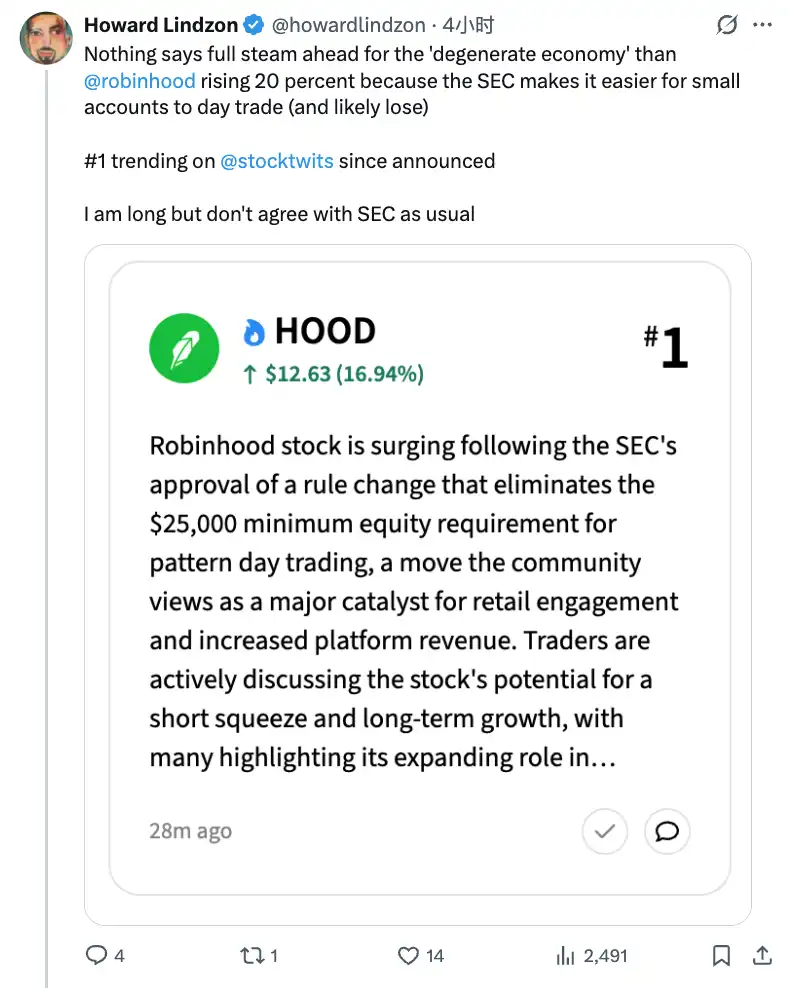
On the same day, X Platform made the cashtag truly actionable for the first time. The cashtag, invented, stolen, shelved for over a decade, was now weaponized right under its inventor's eyes, while the inventor himself was advertising for the other platform.
Why Wealthsimple?
The Cashtag feature was first launched in the United States and Canada, but only Canadian users could click on the cashtag to directly place orders with the brokerage. The reason is simple: Wealthsimple is a Canadian company, so it launched in Canada. The trading partner for the U.S. market has not yet been announced. But the interesting question is: Why Wealthsimple and not another Canadian financial institution?
Wealthsimple is Canada's largest online brokerage, which is its most direct identity. Founded in 2014, it now manages over $50 billion CAD in assets, with a high penetration rate among young Canadian investors. It holds both traditional securities licenses and a digital asset trading license (Wealthsimple Digital Assets), allowing it to handle both stocks and cryptocurrencies, both of which X's Cashtag must support. This requirement is not met by just any institution in Canada.

Meanwhile, Wealthsimple is also a "repeat offender" partner.
In March 2026, just a month before the announcement of the partnership with X, the Quebec Superior Court approved a class-action settlement against Wealthsimple's crypto business. The lawsuit was based on its promotion of "zero-commission" trades without clearly disclosing to users that it profits from the bid-ask spread. The final settlement amount was 750,000 CAD, resulting in an average of 3.34 CAD per investor. Wealthsimple did not admit to any wrongdoing, but the issue of information disclosure had become a public controversy.
Back in 2025, Wealthsimple experienced a data breach incident. A trusted third-party vendor's software package was attacked, leading to unauthorized access to some customers' social insurance numbers and account information. Wealthsimple took control of the situation within hours, completing full notifications and emergency response. From a crisis management perspective, it did not collapse.
To sum up Wealthsimple's status in one sentence: it has stumbled but also recovered. It knows where the regulatory boundaries lie and has real crisis management experience. For X, a new feature aiming to connect social discussion and trading access, such a partner, with a tested track record, actually poses a more foreseeable risk than an untested partner.
The real suspense lies in the U.S. market. Robinhood is testing its own social trading feature (Robinhood Social), Coinbase has more extensive crypto compliance experience but also more SEC friction. Who X chooses in the U.S. will be the true test of whether this model can succeed.
X's Financial Ambitions, Understanding the Timeline in One Picture
The launch of the Cashtag feature is the culmination of a tiered architecture assembly. Looking back at X's actions over the past 16 months, it's clear that each step has been precisely placed:
In January 2025, a partnership was signed with Visa to obtain the fiat-to-fiat transfer infrastructure;
In January 2026, Nikita Bier previewed Smart Cashtags, outlining the financial data layer;
In February, a proactive clarification that "X is not a broker," completing the regulatory separation;
In March, X Money officially announced its public testing plan, and the payment layer came to the surface;
On April 14, Cashtags went live, and on the same day, a partnership with Wealthsimple was announced—the data layer and the transaction layer connected for the first time.
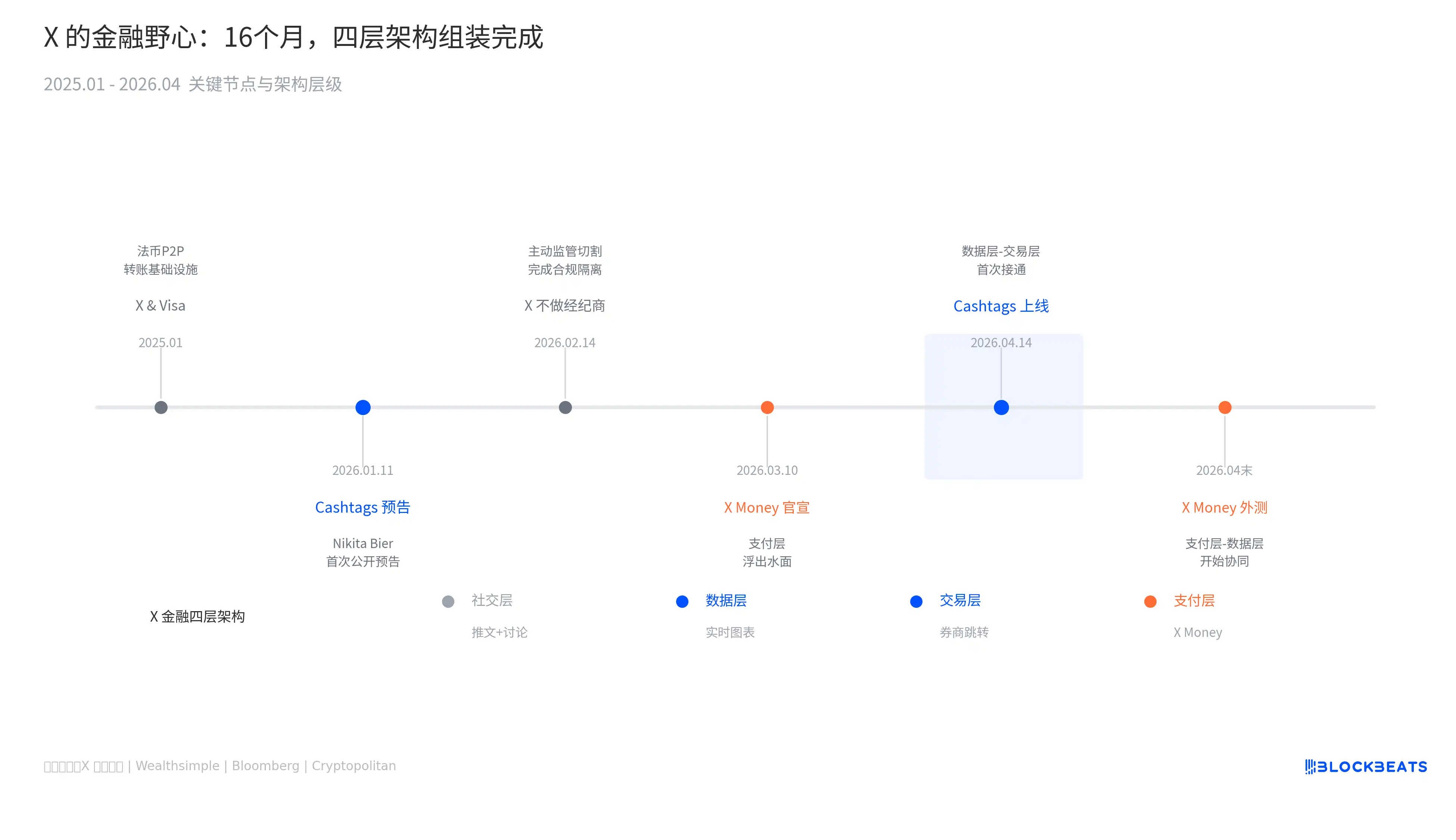
Stacking the four layers together: social layer (tweets + discussions), data layer (real-time charts), transaction layer (brokerage link-outs), payment layer (X Money P2P transfers + 6% APY savings account). Each layer individually has mature competitors, but together, no platform has done this before.
This is the most concrete realization of what Elon Musk has always referred to as a "super app." Starting from attention, first capturing all money-related discussions, and then gradually transforming these discussions into real fund flows. From Lindzon's first $AAPL on StockTwits in 2008 to today, where X platform allows hundreds of millions of users to buy stocks by clicking on this symbol directly, cashtag took 18 years to fulfill its destiny.
You may also like

Japan’s Three Megabanks Plan Joint Stablecoin Issuance in Fiscal 2026
MUFG, SMBC, and Mizuho reportedly plan to jointly issue fiat-pegged stablecoins in fiscal 2026, signaling Japan’s growing push into bank-led digital payment infrastructure.

Humanity Discloses H Token Dual-Chain Attack Details, With Losses on Ethereum and BSC Exceeding $36 Million
Humanity said the H token attack across Ethereum and BSC caused more than $36 million in losses after leaked ProxyAdmin keys enabled malicious contract upgrades and token minting.

White House Discusses CLARITY Act With Law Enforcement Ahead of Senate Vote
The White House discussed the CLARITY Act with law enforcement ahead of a Senate vote, focusing on illicit finance risks and developer protections.

$75 billion in foreign capital has fled, and South Korean retail investors have absorbed it all using leverage

Bitcoin Trading Guide 2026: Strategies for Experienced Traders

What Is XAUT and PAXG? Why Tokenized Gold Is Booming in 2026

Cryptocurrency CEXs are flocking to sell US stocks, and traditional brokerages are facing an "uninvited guest."

Will the SpaceX IPO Hurt Bitcoin? Here's What Traders Are Watching
Foreign selling in the South Korean stock market accelerates, with cumulative net sales reportedly reaching $75 billion this year
On June 9, The Kobeissi Letter, citing Goldman Sachs data, reported that global investors are selling South Korean stocks at an unusually rapid pace. In the latest trading session, foreign investors sold about $801 million worth of Kospi constituent stocks again; total foreign outflows last week reached about $10 billion, and the market has been in net foreign selling on nearly every trading day over the past month. According to the data cited in the report, foreign investors have sold about $75 billion worth of South Korean stocks so far this year. Meanwhile, South Korean retail and institutional investors together recorded roughly $69 billion in net buying over the same period, suggesting that the market’s main buying support has come from domestic capital rather than returning overseas funds. The information currently disclosed still mainly comes from The Kobeissi Letter’s retelling and Goldman Sachs data summaries, while public details on the statistical period and the specific definition of “selling” remain relatively limited.

Fortune Warns of Strategy’s Financing Structure Risks as Bitcoin Premium Narrows
Fortune warned that Strategy’s Bitcoin treasury model faces growing financing risks as MSTR’s net asset premium narrows and preferred stock dividend pressure increases.

Ferrari Challenge Le Mans: Carl Moon to Dominate in WEEX Livery

Sahara AI Responds to SAHARA’s Sharp Drop: No Contract or Product Security Issues Found, Internal Investigation Underway
Sahara AI responded to SAHARA’s 60% price drop, saying no token contract or product security issues have been found and an internal investigation is underway.

WEEX Deposit/Withdrawal Dynamic Island: Your Asset Status, Always in Sight
Scaling Crypto Derivatives: The Digital Asset Infrastructure Behind High-Volume Trading
In the fast-moving digital asset ecosystem, derivatives platforms face an extreme architectural test. High-leverage futures markets demand more than just standard security—they require absolute operational precision, zero-latency matching engines, and ironclad structural scalability, all while navigating intense market volatility.
As global platforms scale to meet these demands, the industry is shifting away from rigid, monolithic setups toward a more agile, "decoupled" infrastructure philosophy.
The Blueprint for High-Volume Copy TradingFor elite global exchanges like WEEX (founded in 2018), this architectural choice becomes critical when scaling high-volume retail features like social copy trading. When thousands of users automatically mirror the real-time strategies of elite traders simultaneously, it triggers sudden, monumental spikes in concurrent transactional volume.
To prevent execution latency or settlement bottlenecks during these peak volatility events, a platform's primary engine must remain entirely dedicated to risk management, copy-trade synchronization, and order matching.
The Architectural Rule: New-generation platforms must separate front-end user execution engines from heavy backend infrastructural overhead to eliminate operational friction.
By separating these layers, platforms can maintain complete sovereignty over their trading environments and user experiences while strategically aligning with institutional-grade infrastructure ecosystems. This strategic framework allows modern exchanges to leverage advanced Digital Asset Custody infrastructure such as Cobo’s behind the scenes, ensuring that backend wallet management scales elastically alongside trading spikes.
Capitalizing on Market Momentum and 400× LeverageIn a derivatives arena where platforms offer up to 400× leverage on perpetual contracts, capital efficiency and market agility are core business metrics. To capture market momentum, an exchange needs the ability to rapidly expand its asset offerings, supporting everything from legacy crypto assets to sudden, trending altcoins across a massive library of trading pairs.
Adopting a flexible, scalable Wallet-as-a-Service (WaaS) solution such as Cobo’s could completely rewrite the development timeline for high-growth exchanges. Instead of spending months of engineering capital building out custom backend wallet architectures for every new blockchain network, platforms can deploy localized infrastructure in days.
This agility allows platforms to instantly scale their listings to over a thousand trading pairs without compromising security or delaying time-to-market. It mirrors the exact operational advantages seen during high-velocity market events, similar to how advanced wallet infrastructure empowers platforms during sudden asset surges; allowing exchanges to pass that speed and liquidity directly to their global user base.
A Mature Foundation for GrowthThe synergy between trusted infrastructure ecosystems and global trading platforms represents the natural evolution of a maturing crypto market. As WEEX continues to scale its global spot and derivatives offerings for over 6 million users, adopting robust backend paradigms proves that platforms no longer have to compromise between cutting-edge trading velocity and uncompromised structural security.

Morning Report | BitMine increased its holdings by 126,971 ETH last week; trader Eugene announced his exit from the crypto market

Wang Chuan: How can one not feel anxious after the neighbor Old Wang made thirty times profit by investing in storage stocks? (Seven) - A quarter-century cycle

Get Paid to Onboard? Try WEEX’s New Homepage with Rewards for Registration, Deposit & Trade
WEEX Custom Layout: Build Your Perfect Trading Workspace in Seconds
Japan’s Three Megabanks Plan Joint Stablecoin Issuance in Fiscal 2026
MUFG, SMBC, and Mizuho reportedly plan to jointly issue fiat-pegged stablecoins in fiscal 2026, signaling Japan’s growing push into bank-led digital payment infrastructure.
Humanity Discloses H Token Dual-Chain Attack Details, With Losses on Ethereum and BSC Exceeding $36 Million
Humanity said the H token attack across Ethereum and BSC caused more than $36 million in losses after leaked ProxyAdmin keys enabled malicious contract upgrades and token minting.
White House Discusses CLARITY Act With Law Enforcement Ahead of Senate Vote
The White House discussed the CLARITY Act with law enforcement ahead of a Senate vote, focusing on illicit finance risks and developer protections.
$75 billion in foreign capital has fled, and South Korean retail investors have absorbed it all using leverage
Bitcoin Trading Guide 2026: Strategies for Experienced Traders
What Is XAUT and PAXG? Why Tokenized Gold Is Booming in 2026


